Plumbers, electricians and builders: what AI needs to know before it recommends you
When someone asks ChatGPT or Google's AI Mode for a tradesperson, the answer depends on a few plain facts. Here's what trades businesses should put where.
· 5 min read
By the Blessed Pixels team
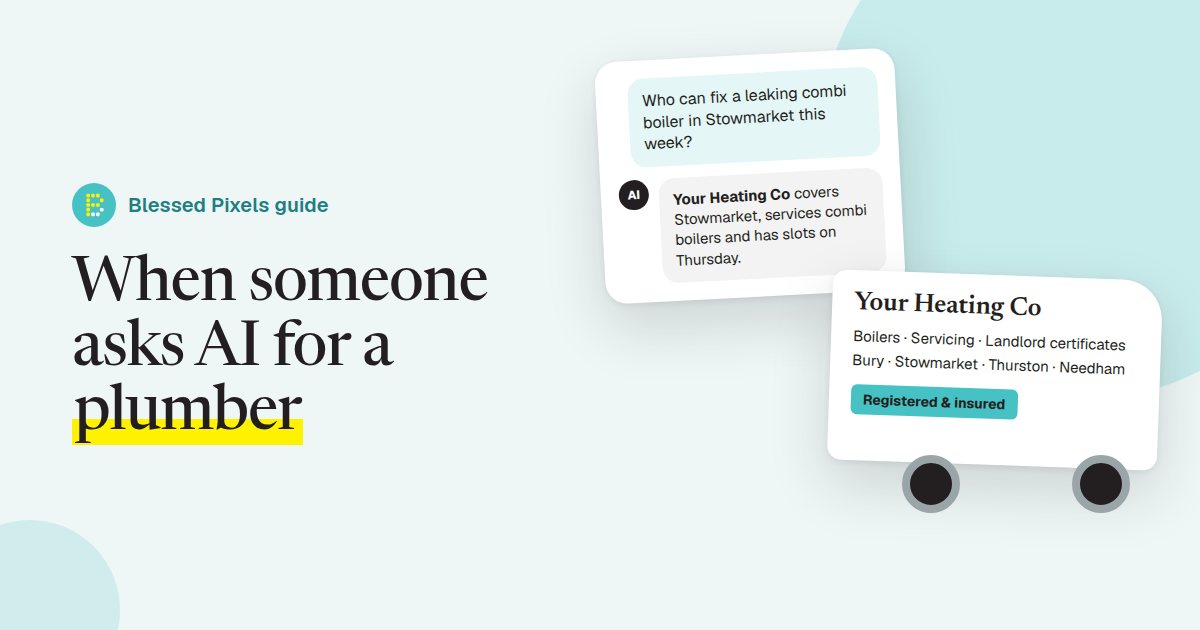
Short answer first. AI tools recommend tradespeople when they can find four things written down clearly: what jobs you do, which towns and villages you cover, when you can come out, and some proof you're qualified and trusted. Most trades websites have the first. Very few spell out the other three in a way a machine can repeat.
A homeowner doesn't ask an AI tool for "a plumber". They ask for "someone who can fix a leaking combi boiler in Stowmarket this week, Worcester Bosch, not too pricey". Every part of that sentence is a fact the tool goes looking for. If your website only says "Professional plumbing and heating services across Suffolk", it doesn't answer any of it.
Why trades get left out of AI answers
Trades websites tend to be built for people who already know you. A logo, a phone number, a gallery and "no job too small". That works fine for word of mouth.
It works badly for a stranger's question, because AI tools build their answer from details. Do you fit EV chargers? Do you do landlord gas safety certificates? Do you cover Thurston, or just Bury? Do you work weekends? If those answers live only in your head, or in a Facebook post from 2023, the tool can't use them.
The fix isn't clever. It's writing the facts down in the places these tools read. Checking all of those places for one business is exactly what our full AI audit does, but you can make a good start yourself.
A page for each job you want more of
One "Services" page with ten bullet points is a very common trades website habit, and an easy one to fix. Give the jobs you want more of their own page, or at least their own section with a heading.
For a heating engineer that might be:
- Boiler installation, with the makes you fit and roughly how long it takes
- Boiler servicing, with what's included and a "from" price
- Landlord gas safety certificates
- Emergency call-outs, with your actual hours
Write each one in the words a customer would use. "Combi boiler replacement" beats "heating system upgrades". Add a "from" price where you can. It's the question people ask most, and a tool that can see a number can mention it.
Then answer the questions people ask before booking, on the page itself. We wrote a whole guide on turning those phone questions into an FAQ page, and trades businesses get more of those calls than most.
Spell out your service area, town by town
This is the big one for trades. "Covering Suffolk" is too vague to match a question about a particular village.
List the towns and villages you actually cover, in plain text, on your website. Not as a map image, because a crawler can't read a map picture. If you cover different areas for different jobs (emergency call-outs nearer home, installations further out), say so.
On your Google Business Profile, set a service area rather than a public address if customers don't come to you. Google's guidelines for representing your business cover how service-area businesses should do this. Make the list match your website.
If you'd like the machine-readable version too, schema.org has types for trades such as Plumber and Electrician, with a field for the area you serve. Getting that structured data right sits on our list of what we can fix for you.
Show the proof: registrations, insurance and reviews
People are careful about who they let into their home, and AI tools tend to mention the reassuring details when they can find them.
Put your registrations on your website as text, with your registration number where the scheme allows it: Gas Safe, NICEIC, NAPIT, OFTEC, TrustMark, whichever apply. A logo on its own is a picture; the words next to it are what gets read. Say you're insured. Mention any guarantee you offer on work.
Reviews do a lot of the describing for you. "Fixed our boiler the same day, really tidy" tells a reader and an AI tool what you're like in your customers' own words. Ask happy customers for a Google review when you finish the job, and reply to them. You can't write or buy reviews, and you shouldn't offer anything in return for them. Asking at the right moment is enough.
These are among the areas we check in every audit, listed on what we audit.
Keep your hours and call-out times honest
"24/7 emergency service" on a website, when the phone goes to voicemail after 7pm, causes trouble twice: an annoyed customer and a review that says so. Write the hours you really work, and if you do emergencies, say when and roughly what a call-out costs.
Then make the hours match everywhere: website, Google Business Profile, Facebook, and any directory such as Checkatrade or MyBuilder if you use one. When three places give three different answers, AI tools have no reason to trust any of them.
Not sure how your site reads to an AI tool right now? Our free AI check shows what it can and can't pick up about your business in about 30 seconds.
Frequently asked questions
Do I need a website if I get all my work from Checkatrade?
It helps. Directories are useful, but you don't control them, and AI tools look at several sources. A simple website with your services, areas and hours backs up what the directories say.
Should I list every village I cover?
List the ones you genuinely want work from. A long list of places you'd rather not drive to just brings calls you'll turn down. Keep it honest and keep it matching your Google profile.
Will showing prices put customers off?
"From" prices tend to help more than they hurt, because they answer the first question people have. They also give AI tools a number to mention. Say what changes the price so nobody feels caught out.
Can I get ChatGPT to recommend my business?
Nobody can guarantee it. What you can do is make your services, area, hours and credentials easy to find and the same everywhere, which makes you a much clearer answer to a specific question.
Does my van or my flyers matter for AI search?
Not directly, since AI tools read the web. But the same rule applies: use the same business name, phone number and web address everywhere, so the van, the flyer and the website all point to one business.